CCleaner browser cookies keep returning
Websites recreate cookies during browsing; review cookie retention choices and sign-in consequences.
This guide explains a cautious way to diagnose the issue, avoid unnecessary changes, and confirm whether the result is resolved. CCleaner product editions and account options may differ, so always check the labels shown in your installed version before proceeding.
Understand the problem before changing settings
Write down what you expected to happen, what actually happened, and the last successful attempt. Note the Windows version, CCleaner edition, and any message shown on screen. This distinction matters because an account sign-in failure, a local application error, and a purchase entitlement problem may require completely different solutions.
When a step mentions an account, purchase, or license, use only the verified service associated with your own transaction. This website does not provide a CCleaner sign-in form or ask for confidential credentials.
Step-by-step troubleshooting
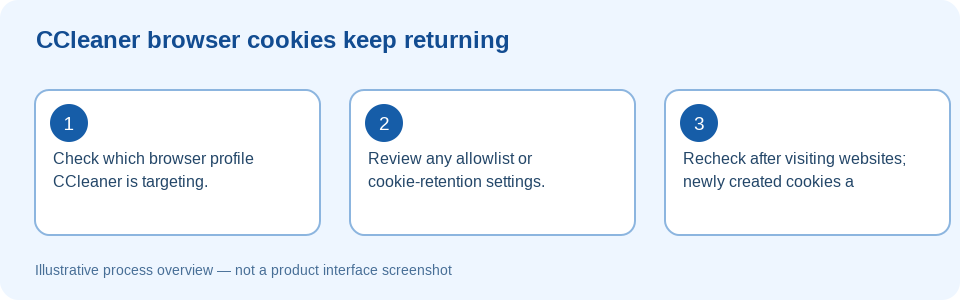
- Step 1. Check which browser profile CCleaner is targeting. Take note of the result before moving to the next step; a changed symptom can identify the underlying cause.
- Step 2. Close the browser before analyzing stored cookies. If this step does not apply to your edition, skip it rather than selecting a similarly named but unrelated control.
- Step 3. Review any allowlist or cookie-retention settings. When changing a setting, record its previous value so you can reverse the change if needed.
- Step 4. Decide whether staying signed in is more important than deleting a particular cookie. Take note of the result before moving to the next step; a changed symptom can identify the underlying cause.
- Step 5. Run a limited cleanup and reopen the browser. If this step does not apply to your edition, skip it rather than selecting a similarly named but unrelated control.
- Step 6. Recheck after visiting websites; newly created cookies are expected. When changing a setting, record its previous value so you can reverse the change if needed.
How to confirm the result
Repeat the original task once after completing the relevant steps. Confirm that the same error no longer appears and that the expected feature or account state is working. If the issue involves a charge, subscription, or license, verify the result against the appropriate receipt or account record rather than relying only on an on-screen message.
Common mistakes to avoid
- Deleting authentication cookies without warning users.
- Confusing browser sync with cookie cleanup.
Use reversible changes first. If you are unsure whether a step could remove personal data or alter Windows behavior, back up important information and seek product-specific guidance before proceeding.
Frequently asked questions
What should I check first?
Start with the exact symptom described in this guide: Websites recreate cookies during browsing; review cookie retention choices and sign-in consequences.
Should I disable security software to fix it?
No. Keep Windows and endpoint protections enabled. Investigate specific block messages and follow your organization’s policy.
What information is safe to share when requesting help?
The product edition, Windows version, exact error text, and a redacted order reference can help. Never share passwords, full license keys, one-time codes, or complete payment details.
What if these steps do not solve the problem?
Stop repeating actions that could change data or billing. Keep a record of what you tried and use verified publisher assistance for product-specific account or entitlement issues.
Related guides
- CCleaner cleaner scan not working
- CCleaner not deleting temporary files
- CCleaner registry cleaning risks and recovery
- CCleaner deleted saved browser passwords
For account or payment issues, never send passwords, verification codes, or complete card details to a third-party help website.